

Introduction
For most of its history, high-quality simulator-based emergency response training meant travel. Trainees flew to a dedicated centre, spent time in a purpose-built simulator suite, and flew home. The training was effective, but the cost model was dominated by logistics rather than learning. Travel, accommodation, time off the job, and the fixed overhead of maintaining a physical installation all added up, often to the point where training frequency was determined by budget rather than by what competency genuinely required.
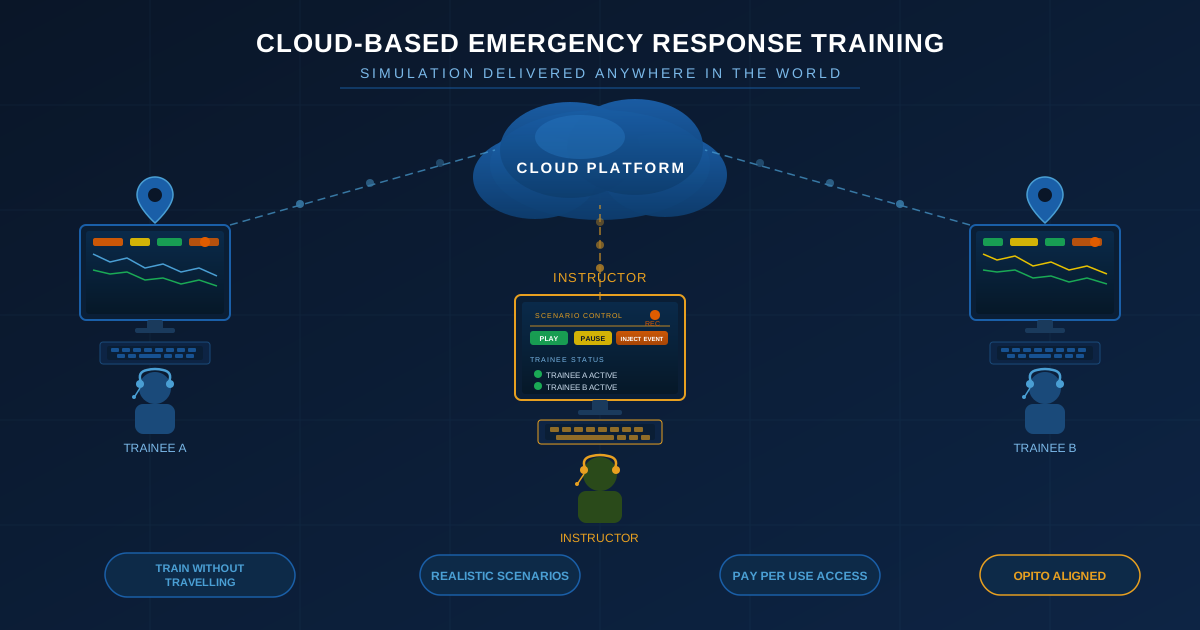
Cloud-based simulation has changed that model significantly. The same training, the same scenarios, the same quality of emergency response preparation that previously required a physical visit to a simulator centre can now be delivered remotely, via a standard computer and internet connection, to trainees anywhere in the world.
This is not a compromise on quality. It is a different delivery model for the same training product, and in many respects a more flexible and cost-effective one. This article explains how it works, what it changes for training managers and operators, and what to look for when evaluating a cloud-based platform.
How Cloud Simulation Works
A cloud-based simulator hosts the simulation environment on remote servers rather than on dedicated hardware at a training centre. Trainees and instructors access it through a web interface, each from their own location. The experience on screen is the same as in a physical suite: realistic control room displays, fire and gas systems, process behaviour, alarms, and communication channels.
The communications element is particularly important. Radio, PA, telephone, and intercom are all simulated through the platform. Trainees and instructors interact by voice in real time, with instructors playing the roles of field operators, muster coordinators, onshore support, and other parties as the scenario requires. The scenario itself develops dynamically, with the instructor controlling pace and events from their own interface.
Performance is recorded throughout, supporting the same structured debrief and competency assessment that on-premise simulation provides. The quality of the training outcome depends on the quality of the simulator model and the skill of the instructor, not on whether the hardware is in the same room as the trainee.
What Changes for Training Managers
The shift to cloud delivery has practical implications across several dimensions that training managers are directly responsible for.
Travel and Logistics Costs
The most immediate financial impact is the elimination of travel and accommodation. For organisations sending personnel to international training centres, this is often the largest single cost in the training budget. A course that costs a certain amount to deliver on-site may cost two or three times as much once flights, hotels, and subsistence are factored in.
Cloud delivery removes those costs entirely. The training fee is the training fee. There are no add-ons for getting people there and back.
For organisations with personnel distributed across multiple locations, this is particularly significant. Running a team exercise that brings together participants from different countries is logistically straightforward online in a way that it simply is not when everyone has to be in the same room.
Training Frequency
One of the most consistent findings in competency research is that skills developed through simulation degrade without regular practice. The traditional model of infrequent extended courses, driven partly by the logistical overhead of travelling to a centre, is not optimal for maintaining genuine readiness.
Cloud delivery makes it practical to train more frequently. Shorter, more focused sessions can be scheduled at intervals that reflect what the competency actually requires, rather than what the travel budget allows. A refresher exercise that would previously have required a flight and an overnight stay can be delivered in a morning, remotely, at a fraction of the cost.
This shift from event-based training to more continuous competence maintenance is one of the most significant changes that cloud delivery enables.
Scheduling Flexibility
Offshore rotations, shift patterns, and operational demands make it genuinely difficult to coordinate training for groups of personnel at a fixed location on a fixed date. Cloud delivery removes the location constraint. Trainees can participate from wherever they are, whether that is onshore between rotations, on a support vessel, or at a remote office.
This flexibility is particularly valuable for organisations with international operations. Running a training exercise across time zones, with participants in different countries, is straightforward on a cloud platform in a way that would be logistically complex with physical simulation.
Rapid Response to Training Needs
When procedures change following an incident, when a new asset comes online, or when a specific risk area is identified as requiring attention, the ability to deploy training quickly matters. Cloud platforms allow new scenarios to be created and delivered without waiting for a course to be scheduled at a physical centre. The response time between identifying a training need and addressing it can shrink from weeks to days.
What Does Not Change
It is worth being clear about what cloud delivery does not change, because some assumptions about remote training do not hold when the platform is well designed.
Scenario realism is not reduced. A cloud-based simulator that accurately models control room behaviour, fire and gas systems, process dynamics, and environmental conditions provides the same quality of scenario as an on-premise system. The fidelity of the training experience is determined by the quality of the model, not its location.
Communications realism is not reduced. Real-time voice communication, simulated radio channels, PA, and telephone are all fully functional in a cloud environment. The experience of managing communications under pressure during a simulated emergency is the same whether participants are in the same room or on different continents.
Assessment capability is not reduced. Performance recording, structured debrief, and competency assessment against OPITO or NOGEPA standards are all supported in the same way as on-premise delivery.
Instructor involvement is not reduced. The quality of a simulator exercise depends heavily on the instructor. That does not change with cloud delivery. What changes is that the instructor does not need to be physically co-located with the trainees.
Case Study: Arab Academy for Science, Technology and Maritime Transport
The Arab Academy for Science, Technology and Maritime Transport, based in Alexandria, has been one of the leading training organisations in the Middle East for many years. The academy installed the Pisys on-site MEM simulator in 2017 and used it extensively for Major Emergency Management training with oil and gas clients.
When COVID restrictions made it impossible to hold courses in the physical simulator suite, the academy faced a serious problem. The value of its training programme depended on the realism that simulation provided, and no alternative could match it. Adapting to purely classroom-based delivery was not an acceptable solution.
The academy adopted the Pisys cloud simulator, and their instructors were able to recreate the exact scenarios they had been running on-site, delivered to students joining remotely. The key features of the on-site suite, real-time voice communications, PA, radio and telephone, realistic alarms and control room interfaces, instructor-controlled scenario development, were all available through the cloud platform.
Significantly, the academy continued to use the cloud system after COVID restrictions lifted, running it alongside the on-site simulator rather than reverting entirely to the original model. The flexibility, reduced overhead, and ability to serve international students without requiring them to travel to Alexandria made the cloud option permanently valuable, not just a pandemic workaround.
The experience of the Arab Academy reflects a pattern that is becoming common: organisations that adopt cloud simulation out of necessity, or to serve a specific need such as international clients or remote personnel, discover that the practical advantages make it a permanent part of their training delivery rather than a temporary substitute.
Pay-Per-Use and What It Means for Smaller Operators
One of the barriers to simulation-based training for smaller operators and training organisations has historically been the capital cost of installing and maintaining a physical system. A simulator suite requires hardware, space, ongoing maintenance, and the overhead of keeping it current as models and procedures change.
Cloud delivery removes the capital barrier. Pay-per-use and subscription models mean that organisations access simulation capability in proportion to how much they use it, without a large upfront investment. This changes the economics of simulation for a significant part of the market.
For a small operator that needs to train a relatively small number of personnel, and for whom a dedicated simulation centre would never be economically justifiable, cloud access makes high-quality simulation viable for the first time. For a training provider looking to add simulation capability to their programme without the capital risk of a physical installation, cloud access provides the same outcome at a fraction of the cost.
For larger organisations with established on-premise systems, pay-per-use cloud access provides overflow capacity, remote access for distributed teams, and a cost-effective option for refresher training that complements rather than replaces the on-site investment.
Evaluating a Cloud Simulation Platform
Not all cloud simulation platforms are equal. For training managers evaluating options, the following are the most important things to assess.
Model quality. The simulation model is the foundation of the training. It needs to accurately replicate the behaviour of the systems and environments relevant to your trainees. A platform with a broad library of validated models, including offshore platforms, FPSOs, jack-ups, semi-submersibles, onshore facilities, and wind farm environments, provides more flexibility than one built around a narrow scenario set.
Communications fidelity. Radio, PA, and telephone simulation need to be realistic enough to replicate the communication demands of a real emergency. This is non-negotiable for OPITO-aligned training, and it is where some platforms fall short of what on-premise systems deliver.
Standards alignment. If training needs to meet OPITO, NOGEPA, or other recognised competency standards, the platform should explicitly support those standards, with scenario structures and assessment criteria mapped to the relevant learning outcomes.
Instructor tools. The quality of a simulator exercise is heavily dependent on the instructor. The platform should give instructors the tools they need to create and control scenarios, introduce complications, monitor individual trainees, and pause for structured discussion.
Technical reliability. Latency and connectivity issues degrade the training experience. A well-designed cloud platform allocates servers geographically close to both instructors and trainees, minimising latency and supporting stable real-time communications.
Security. When your training platform handles sensitive operational data, emergency procedures and personnel records, the provider's security credentials matter as much as the software itself. Standards such as ISO27001 are globally accepted as markers of robust data security.
Support and onboarding. Transitioning from on-premise to cloud delivery, or adopting simulation for the first time, requires support. The provider's track record for implementation support and ongoing responsiveness is worth investigating through references and case studies.
Conclusion
Cloud-based simulation is a more flexible, more accessible, and in most cases more cost-effective way to deliver the same quality of training that has always been the hallmark of well-designed simulation programmes.
For training managers, the practical implications are significant: lower costs, greater scheduling flexibility, more frequent training, and the ability to reach distributed teams without the logistical overhead that has historically limited how much simulation organisations could realistically afford to use.
The organisations that take advantage of these changes now, shifting from infrequent event-based training to more regular, accessible, cloud-delivered simulation, will build and maintain competency more effectively than those that continue to treat simulation as something that only happens when people can travel to a centre.
The Pisys cloud simulator supports OPITO MEMIR, OIM, CRO and related standards, with the same scenario library and assessment capability as the on-premise system. Click Here to see it in action, or read how the Arab Academy used cloud delivery to maintain training quality during COVID and beyond.
