

Understanding the Difference Between Hazards and Risks
In risk management, a common question is often asked: "When is a risk not a risk?" This question underscores the vital distinction between two key concepts - hazards and risks. While they are closely related and often used interchangeably, understanding their differences is crucial for effective risk management strategies. Here's our take on the subject:
Defining Hazards and Risks
Let's first define what we mean by hazards and risks:
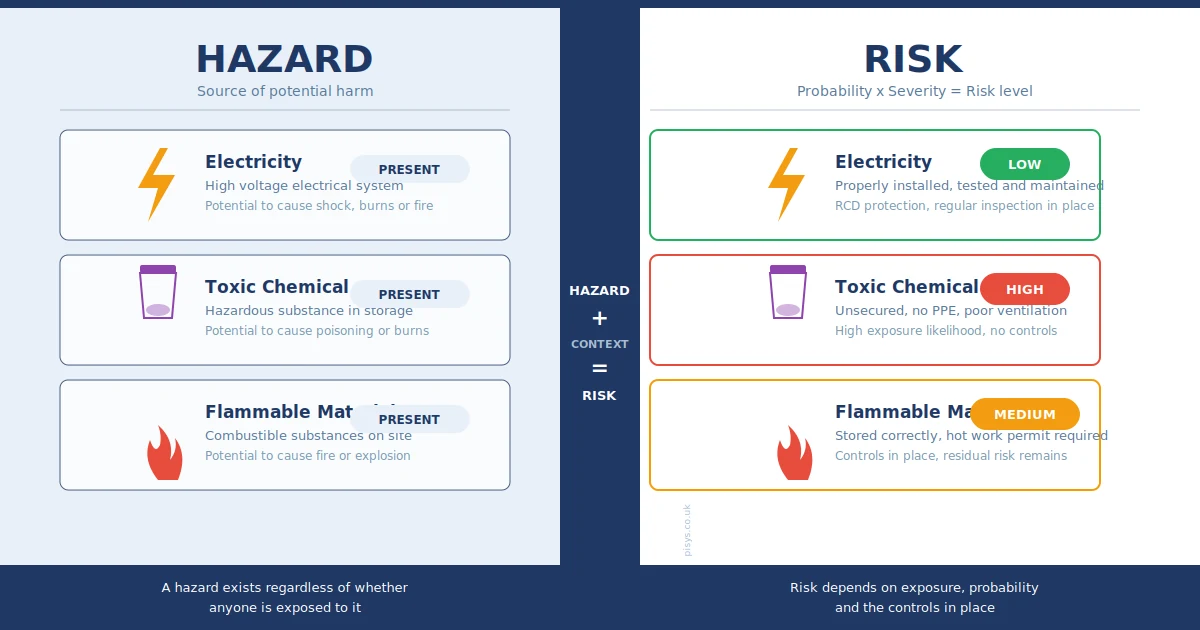
- Hazards: A hazard is any source of potential damage, harm, or adverse health effects on something or someone under certain conditions. Hazards can be physical, such as a slippery floor; chemical, like a toxic substance; or even environmental, such as a flood-prone area.
- Risks: Risk, on the other hand, is the chance or probability that a person will be harmed or experience an adverse health effect if exposed to a hazard. It also pertains to the extent of the potential damage.
When a Hazard is Not a Risk
The key to distinguishing when a hazard is not a risk lies in the context of exposure and probability. A hazard becomes a risk only when there is a likelihood of it causing harm in a specific context. For example, a highly toxic chemical is a hazard, but if it is securely contained and handled with appropriate safety measures, the risk of it causing harm is significantly reduced.
Scenario-Based Understanding
Consider a mountainous terrain; it is a hazard for hikers due to its potential for causing injuries. However, for an experienced hiker with the right equipment and knowledge of the terrain, the risk might be minimal. In contrast, for an inexperienced hiker without proper gear, the same terrain presents a much higher risk.
The Role of Control Measures
Control measures play a crucial role in transforming a hazard into a 'non-risk.' Implementing robust safety protocols, training, and emergency preparedness can effectively mitigate the risks associated with a hazard.
For instance, electricity is inherently a hazard due to its potential to cause shock or fire. However, in a home with proper electrical installations, safety switches, and routine maintenance, the risk of an electrical accident becomes negligible.
Misconceptions and Mismanagement
A common misconception in risk management is overestimating or underestimating the difference between hazards and risks. Overestimating risks can lead to unnecessary precautions and resource allocation, whereas underestimating them can result in inadequate safety measures.
How a Permit to Work System Supports Hazard and Risk Analysis
Understanding the difference between a hazard and a risk is one thing — putting that distinction into practice at the point of work is another. This is where a well-designed permit to work system adds real value.
A PTW system forces a structured conversation about risk at the right moment. Before any hazardous task begins, the permit issuer must consider the specific hazards present in that location, the controls already in place, the competence of the people doing the work, and the conditions on the day. This is a practical application of exactly the hazard-to-risk assessment described above.
Separating hazards from risks in the permit process
A good PTW system helps permit issuers make the hazard-to-risk distinction systematically. A toxic chemical stored in a sealed container is a hazard but not an immediate risk. The permit process captures that distinction by requiring the issuer to specify the actual conditions of the task, not just list everything that could theoretically go wrong.
Where controls are in place and adequate; correct PPE, gas testing, isolation confirmed, the permit records that fact. Where controls are absent or insufficient, the permit workflow prevents authorisation until those controls are in place. In this way, the permit system operationalises the difference between hazard and risk rather than leaving it to individual judgement.
Real-time visibility of active risks
A digital PTW system also provides ongoing visibility of active permits across a site, which is critical for SIMOPS management. If two tasks are running simultaneously that individually represent acceptable risks, but together create a new interaction hazard, the permit board makes that visible in a way that paper systems or spreadsheets never can.
The audit trail
When something goes wrong, investigators need to understand what was known, what was decided and why. A good PTW system captures that decision-making process; not just what the permit said, but who authorised it, what controls were specified and whether conditions changed after issue.
The Pisys Permit to Work system is used by organisations across industries including oil and gas, food and drink, manufacturing, energy and education to bring structure, visibility and accountability to this process.
Conclusion
Understanding the difference between hazards and risks is essential in risk management. A hazard poses a potential threat, but it is the context, likelihood, and severity of the outcome that determines whether it is a risk. This distinction is crucial for prioritizing safety measures, allocating resources effectively, and maintaining a balanced approach to managing potential dangers. In essence, recognizing when a risk is not a risk is fundamental to creating safer, more efficient, and resilient environments.